About Untangling Family History
I began researching my own family history when I was thirteen, sitting at the kitchen table with my mum and my grandmother. She was telling us what she knew about her mother’s family. We were lucky in some ways: she had been brought up by her grandmother, and her own great-grandmother, born in 1840, was still alive until she was eight. So she carried stories that reached back far further than most people can remember.
But even then, we had our first brick wall. We knew the name of her father, and nothing else.
This was long before the internet made records easy to search. To find anything, we went to St Catherine’s House in London to look through the large printed certificate indexes. We used microfiche readers borrowed from our local family history society to search the IGI. We ordered microfilms of census records and waited weeks for them to arrive.

The piece of paper my grandma wrote out for us that started my journey in family history
It was slow, careful work. It taught me how to think like a researcher: how to follow a trail, how to test a theory, and how to recognise when something does not quite fit. Those skills have stayed with me ever since.
Over the years, my own (and my husband's) family history has taken me across much of the UK and Ireland. I have researched lines in Sussex back into the fifteenth century, as well as families in the Midlands, London, Wales, Ireland, Lancashire, Yorkshire, and the West Midlands. Along the way I have "met" an Irish washerwoman, a Royal Marine demoted to the ranks, a diarist, a yeoman farmer, many agricultural labourers (ag labs) and families shaped by poverty, inheritance, migration, and chance. I have worked with wills, poor law records, apprenticeship papers, workhouse registers, parish registers, and census returns, learning how different types of evidence fit together.
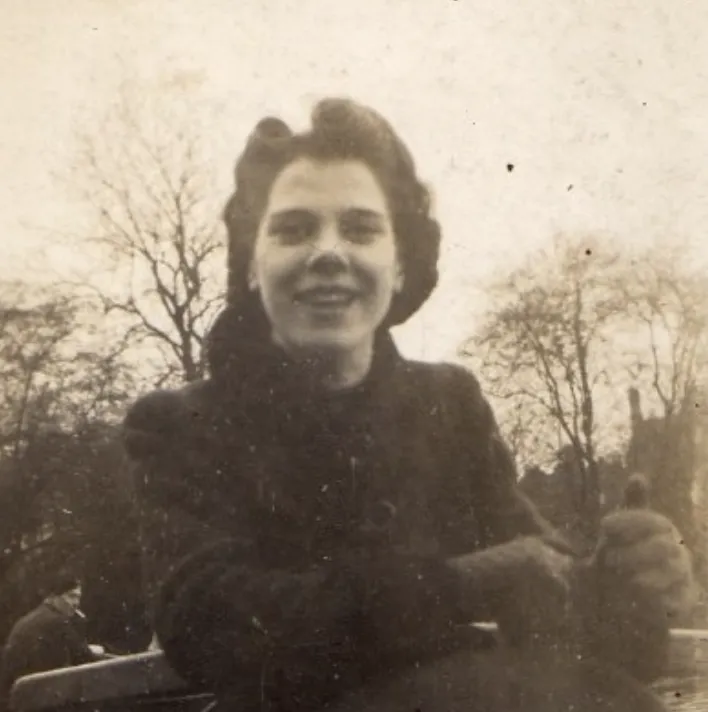
My Nanna during the second world war.
When DNA made it personal
Years later, family history became deeply personal in a new way. When my other grandmother died, we discovered that my dad’s father was not the man who had brought him up. All we had was a name, an accent, and a single photograph from my great-aunt’s wedding. His name was Ted, and he was Australian.
That was it.
Using military records, newspaper notices, and Australian archives, I began to piece together a story. Lines were drawn, then crossed out, then redrawn. Some connections looked promising and turned out to be wrong. Others seemed unlikely until something small made them click.
It was DNA that finally solved it.
Learning to work with DNA brought a whole new layer of complexity: understanding how people are related across generations, spotting patterns in matches, and slowly building confidence that you are moving in the right direction. Then comes the moment that is both thrilling and frightening: a close connection appears, and you realise that someone on the other side may have no idea that you exist.
Our story had a happy ending. We connected with my dad’s siblings, and we are now in regular touch. But I am always aware that it could have been very different. DNA opens doors that cannot be closed again, and that is why this work must be done with care, consent, and respect.
Oh, and it also helped us find my Grandma's dad too - not a Canadian military policeman as we thought but a man from Hampshire stationed across the road from my great grandma in World War One.
Why I do this work
Family history is not just about names on a page. It is about real people, real lives, and sometimes real surprises.
I founded Untangling Family History to offer a kind of genealogy that is thoughtful, ethical, and human. Whether you are starting with nothing, checking an existing tree, or trying to understand DNA results, my aim is to help you make sense of what can be known, what is uncertain, and what it all means.
How I work
I work with people in the UK, Australia, and beyond, using:
Traditional archival research
Census, parish, and civil records
Migration and overseas tracing
DNA and genetic genealogy, including DNA Angel support
Every project is approached with care for the living as well as the past.
What you can expect
People often come to me feeling unsure, stuck, or worried they have gone down the wrong path. My role is not to judge, but to help you find your footing.
You can expect:
Careful, well-evidenced research
Clear explanations in plain English
Realistic expectations
Respect for you and your family
Your story matters. It deserves to be handled with skill and kindness.

Ready?
If you would like to explore your family history, you are welcome to get in touch.
Copyright 2026 | Untangling Family History| Terms & Conditions | Privacy