How to Start Family History Research (A Calm Beginner’s Guide)
Start Here: How to Begin Your Family History (Without Getting Overwhelmed)
Starting your family history can feel daunting. You might think you need specialist knowledge, expensive subscriptions, or hours of spare time before you can even begin.
You don’t.
Every family historian — including professionals — starts in exactly the same place: with themselves, a few names, and a lot of unanswered questions.
This guide is here to help you begin calmly, clearly, and without pressure.
Start with Yourself and Work Backwards
The biggest mistake people make is trying to jump straight to great-great-grandparents or dramatic discoveries.
Instead, start with what you know.
Write down:
Your full name
Your date and place of birth
Your parents’ names, dates, and places
Your grandparents, if you know them
Work backwards one generation at a time. This creates a solid foundation and reduces confusion later.
Family history is not about speed. It is about accuracy and understanding.
Talk to Relatives While You Still Can
Before searching online, talk to people.
Conversations with parents, grandparents, aunts, uncles, or older cousins can uncover:
Nicknames or name changes
Approximate dates (“around the war”, “before we moved”)
Places that never appear on certificates
Family stories, tensions, or silences
You do not need a formal interview. A cup of tea and a notebook is enough.
My Nanna told me we her mum had said we were related to the Rowntrees - she was close, my 3x great grandmother was a Maynard. We can only assume she got the names of her confectioners muddled up!
If possible, note who told you what. Memory is valuable, but it is also subjective — and that is part of the story too.
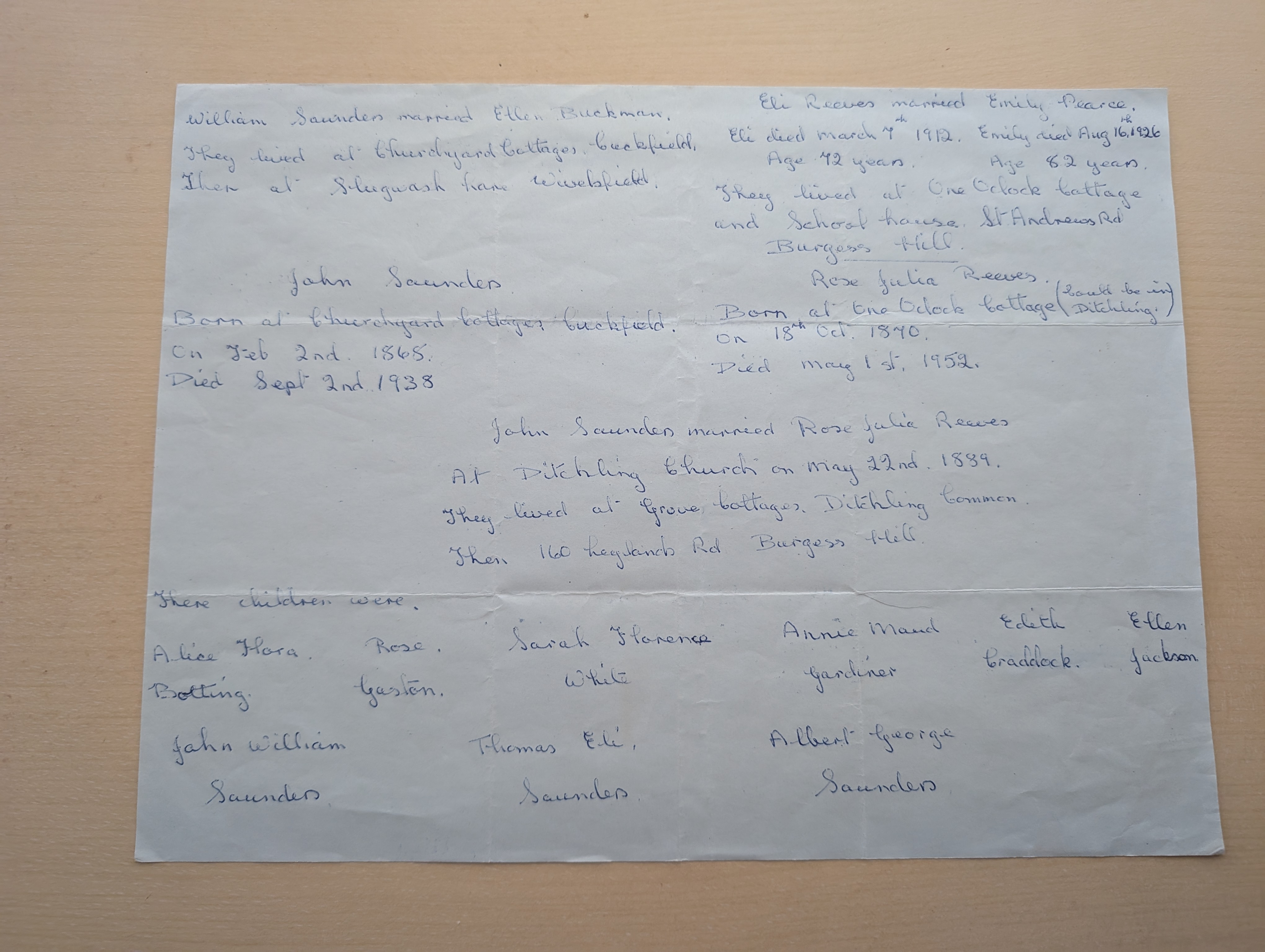
The piece of paper my maternal grandmother wrote out with everything she could remember about her grandparents family
Write It Down — Even If You’re Not Sure
You do not need perfect information to begin.
Write down:
Names (with spellings if you’re unsure)
Approximate dates (use “c. 1920” if needed)
Places, even if it’s just a town or county
Use question marks. Use brackets. Make notes like “not sure” or “possibly”.
Family history is built on provisional information that becomes clearer over time. Waiting for certainty often means never starting.
Keep It Simple at First
Before signing up to multiple genealogy websites, start with something straightforward:
A notebook
A Word or Google document
A basic family tree sketch
This helps you see what you already know — and, crucially, what you don’t.
Once you understand your gaps, online records become far more useful and far less overwhelming.
You Are Not Behind
There is no correct pace for family history.
You are not behind because:
You are only just starting
You do not know exact dates
Your family story feels complicated
You have gaps, silences, or contradictions
Every family historian starts here — with questions, fragments, and curiosity.
The work unfolds one step at a time.
Remember
You do not need to know everything to begin.
You do not need to get it right first time.
You are exactly where every family historian starts, and that is enough.
If you would like careful, ethical help taking your next step, you can explore my research services or get in touch when you are ready.
Need help untangling what you’ve found?
Whether you are stuck, confused by records, or unsure how to move from notes to research, I can help. I work with people at every stage, including those who are just starting.