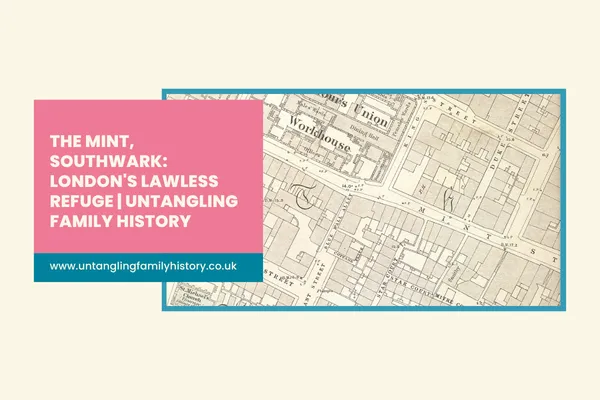
The Mint, Southwark: London's Lawless Refuge | Untangling Family History
Where London's Desperate Found Sanctuary
Tucked away in the backstreets of Southwark, just south of the Thames, there once existed a neighbourhood so lawless, so overcrowded, and so notorious that bailiffs feared to enter it and respectable Londoners crossed the street to avoid it. This was The Mint a place where debtors hid, criminals thrived, and the desperately poor clung to survival in some of the most squalid conditions imaginable.
If your family history research leads you to The Mint, you're stepping into one of the most colourful — and darkest — corners of London's past.

The Origins: How The Mint Got Its Name
The story of The Mint begins, somewhat ironically, with royalty. In the 1540s, Henry VIII established a royal mint at Suffolk Place, a grand mansion near what is now Mint Street in Southwark. Coins were struck here for a time, though the operation was relatively short-lived. The mansion itself eventually fell into decay and was subdivided, but the name stuck — and the neighbourhood that grew up around it would become famous for reasons Henry could never have imagined.
Suffolk Place had once been the London residence of Charles Brandon, Duke of Suffolk, Henry VIII's close companion. After the Crown took possession, the building's gradual decline mirrored the trajectory of the area itself — from aristocratic grandeur to grinding poverty.
A Place Beyond the Law
What made The Mint truly unique was its status as a liberty, an area that claimed ancient privileges of sanctuary. In medieval England, certain places, often associated with religious houses or royal properties, offered protection to those fleeing justice or debt. While most of these sanctuaries were abolished during the Reformation, some areas, particularly in Southwark, clung stubbornly to their ancient rights.
The Mint became the most infamous of these holdouts. Within its cramped, winding streets, debtors could not legally be arrested. Bailiffs who ventured in risked being attacked by mobs of residents who had every reason to keep the law at arm's length. For those drowning in debt, and in an age when debt could land you in prison indefinitely, The Mint offered the only alternative to the horrors of the Marshalsea or King's Bench prisons, both of which stood just minutes away.
The irony was stark: on one side of Borough High Street, debtors rotted in prison; on the other, in The Mint, they lived free, after a fashion.
Life Inside The Mint: A World Apart
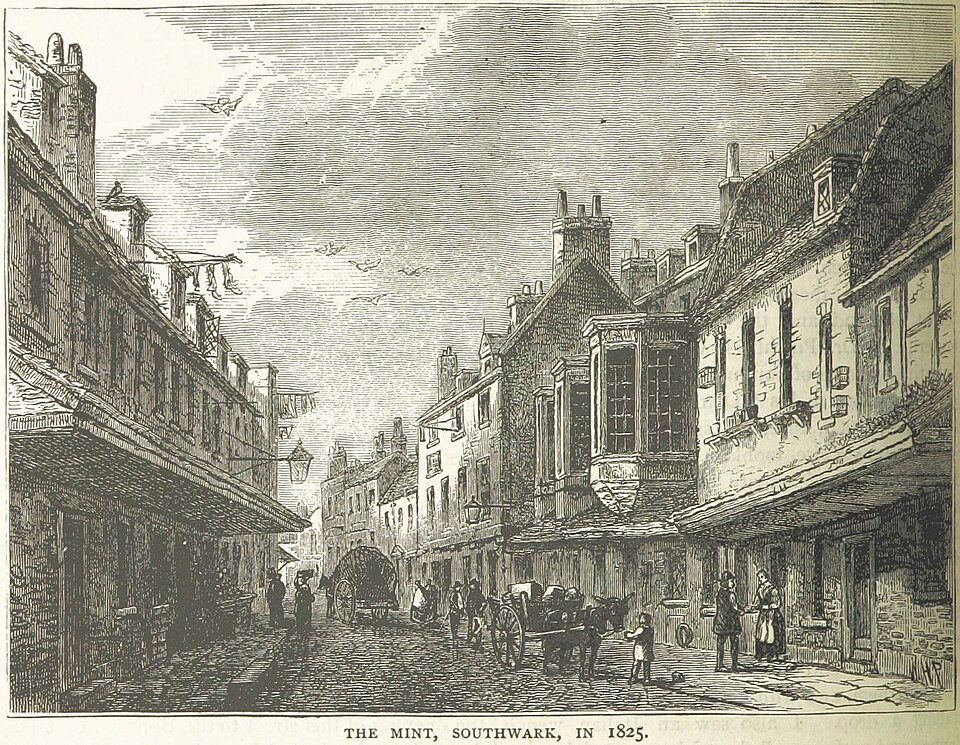
To step into The Mint was to enter another world entirely. Contemporary accounts paint a vivid and deeply unsettling picture.
The streets were narrow, dark, and filthy. Houses that had once been respectable were divided and subdivided again into tiny rooms, each crammed with families and individuals who had nowhere else to go. Sanitation was virtually non-existent. The stench was appalling. Disease was rampant.
The residents — known contemptuously as "Minters", were a mixed and volatile community:
Debtors of every sort, from failed tradesmen to ruined gentlemen, hiding from creditors who would see them imprisoned
Petty criminals - pickpockets, thieves, con artists — who used the sanctuary as a base of operations
Sex workers plying their trade in the alehouses and lodging houses
Deserters from the army and navy
The simply destitute - widows, orphans, the sick, the old, and the broken, who had fallen through every other safety net society offered
A strange sort of community developed. The Mint had its own informal rules and hierarchies. New arrivals were expected to pay a kind of "entrance fee" — buying drinks for established residents at one of the many alehouses. Those who refused could find themselves roughly treated. There were reports of mock courts and kangaroo trials held by the Minters to settle disputes among themselves.
Violence was commonplace. Drunkenness was endemic. Yet amid the squalor, there were also stories of solidarity — of residents banding together to drive out bailiffs, of collections taken up for those in the direst straits, of a rough and ready sense of community forged in shared desperation.
"The Mint Is Up!"
The cry of "The Mint is up!" was one that struck fear into bailiffs and their assistants. When word spread that officers of the law had entered the neighbourhood, residents would pour out of their lodgings, armed with whatever came to hand — sticks, stones, chamber pots, and worse. Bailiffs were beaten, stripped of their clothes, and chased through the streets. Some were lucky to escape with their lives.
This was not mere thuggery (though there was plenty of that). For many Minters, keeping the bailiffs out was a matter of survival. Arrest for debt meant prison — and debtor's prison in the 18th century was a nightmare. Prisoners had to pay for their own food and lodging within the prison walls. Those without money could literally starve. Families were torn apart. There was no fixed sentence, you stayed until your debts were paid, which for many meant you stayed forever.
Little wonder, then, that the residents of The Mint fought so fiercely to preserve their precarious freedom.
The World Around The Mint
To understand The Mint, you need to understand the broader landscape of Southwarkin this period. Southwark had always been London's wilder sibling, the place across the river where the rules were different.
In Elizabethan times, it had been the home of theatres, bear-baiting rings, and brothels, entertainments banned within the City of London proper. By the 17th and 18th centuries, its character had shifted but its reputation remained. Southwark was a place of:
Prisons - the Marshalsea, the King's Bench, the Clink, the Borough Compter, and the White Lion all stood within a remarkably small area
Coaching inns - Borough High Street was the great departure point for travellers heading south from London, and its famous galleried inns (the Tabard, the George, the Talbot) bustled with life
Markets - the ancient Borough Market was already centuries old
Industry - tanneries, breweries, and other trades that were too noxious or too disreputable for the City itself
The Mint sat at the heart of this teeming, chaotic world, a pocket of lawlessness in an already rough neighbourhood.
The Crackdown: The Act of 1723
By the early 18th century, the government had had enough. The Mint's reputation was a national scandal. It was seen as an affront to the rule of law and a haven for every kind of vice and criminality.
In 1723, Parliament passed An Act for the more effectual preventing Frivolous and Vexatious Arrests, and for the more easy Recovery of Debts(9 Geo. I, c. 28), which specifically targeted The Mint and other remaining sanctuary areas. The key provisions were severe:
It became a criminal offence to claim the privilege of sanctuary from debt
Anyone harbouring debtors in former sanctuary areas could be prosecuted
Resistance to lawful arrest within these areas was made a serious crime
Existing residents were given a short grace period to settle their affairs
The Act effectively ended The Mint's status as a sanctuary overnight. Bailiffs could now enter freely, backed by the full force of the law. For the hundreds of debtors sheltering there, the consequences were devastating. Many were arrested and thrown into the very prisons they had spent years trying to avoid. Others fled to other parts of London, disappearing into the vast, anonymous city.
From Sanctuary to Workhouse: A New Kind of Institution
The end of sanctuary did not mean the end of suffering on Mint Street. Just six years after Parliament stripped away the area's ancient privileges, a new institution rose in their place — one that would cast its own long, grim shadow over the neighbourhood for nearly two centuries.
In 1729, the parish of St Saviour's established a workhouse on Mint Street to manage its growing population of paupers. Where debtors had once hidden from the law, the destitute would now be housed, put to work, and, in theory, cared for.
The Early Years
In the beginning, the operation was modest. An early record from October 1731, published inAn Account of Several Workhouses, gives us a rare and surprisingly gentle snapshot of life inside:
"There are now in it 68 Men, Women, and Children, of which all that are able, spin Mop-Yarn, and Yarn for Stockings, which are knit by the Women; and beside this Work, 25 Children are taught to read, and say their Catechism."
Sixty-eight souls. Spinning yarn. Children learning to read. It sounds almost wholesome, a small, manageable community doing honest work and receiving basic education. But this quiet beginning would give way to something far darker as the decades wore on and Southwark's population, and its poverty, exploded.
"Please, Sir, I Want Some More"
The St Saviour's Union Workhouse at Mint Street holds a remarkable, if unconfirmed, place in English literary history. It is widely believed to have provided Charles Dickens with the model for one of the most famous scenes ever written: the moment inOliver Twist (1837) when a starving boy dares to approach the workhouse master and ask for more gruel.
The connection is compelling. As a boy of around twelve, following his father's imprisonment for debt in the Marshalsea (just minutes away), the young Dickens lodged in nearby Lant Street and walked past Mint Street every day on his way to work at Warren's Blacking Factory at Hungerford Stairs, where he was set to the miserable task of pasting labels on pots of boot polish.
Every day, the young Charles would have seen the pauper children of the Mint Street Workhouse, children not so different from himself, being marched to nearby workshops and factories. The sight clearly left its mark. Dickens never forgot what it felt like to be a child on the edge of destitution, and those memories fuelled a lifetime of writing about poverty, injustice, and the cruelty of institutions that were supposed to help the vulnerable.
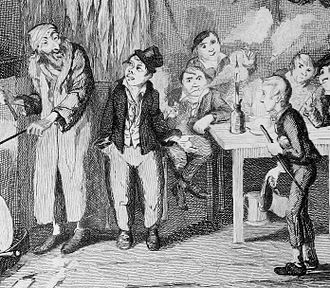
George Cruikshank original etching of the Artful Dodger (centre), here introducing Oliver(right) to Fagin (left)
As an adult, Dickens returned repeatedly to the streets of his difficult childhood. His journalistic writings reveal that he frequently went on fact-finding missions to schools, hospitals, factories, workhouses, and slums across London. He revisited the Marshalsea, the prison that had haunted his childhood, and it seems highly likely that he would also have visited the workhouse on Mint Street, gathering the kind of precise, observed detail that made his fiction so devastatingly real.
Whether or not the Mint Street Workhouse is the workhouse in Oliver Twist, there is no question that it was part of the landscape, both physical and emotional — that shaped Dickens' imagination. When Oliver holds up his bowl and makes his trembling request, the echoes of Mint Street are hard to ignore.
"A Den of Horrors": The Lancet Investigation
Whatever the workhouse's conditions may have been in 1731, by the middle of the 19th century they had deteriorated catastrophically.
In the 1860s, The Lancet, Britain's leading medical journal, launched a groundbreaking investigation into conditions in London's workhouses and their infirmaries. What their investigators found at Mint Street was appalling, even by the grim standards of the Victorian poor law system.
Their report is worth quoting at length, because it captures, in the measured but horrified language of medical professionals, what life was really like for the most vulnerable people in Southwark:
"For the last three years and a half this house appears to have suffered from various epidemics, and especially from typhus. Many cases are admitted into the house from the neighbourhood; but many are developed in the house, and apparently in this way: The tramp ward for the women is a miserable room, foul and dirty, with imperfect light and ventilation, the floor being simply bedded with straw. Into this open sty the women are passed in, often with little or no clothing; and there, in considerable numbers, they pass the night. There being no watercloset attached, a large can or tub is placed in the room. This is the sole accommodation which the apartment possesses."
The investigators noted that there was no matron to look after the women in the tramp ward. The workhouse master himself, the man responsible for running the institution, described the place in shockingly candid terms:
"The master informed us that there is no matron to look after the women, and that the place was really 'a den of horrors'…"
When the person in charge of a workhouse calls it "a den of horrors," you know that conditions have passed beyond mere neglect into something truly terrible.
The Lancet's conclusion was unequivocal:
"We cannot doubt that, with such a history and so many surroundings, it is our duty to condemn this workhouse, which ought to be removed, and one built better adapted to fulfil its duties to the poor and sick of the neighbourhood."
What They Ate
The Lancet investigators also recorded the daily food rations at Mint Street, a stark reminder of just how little sustained the bodies of the men, women, and children who lived there:
Full Diet (Male and Female)
Read those figures again. Four ounces of bread and butter for breakfast — that's roughly a single thin slice. A pint of tea to wash it down. For the main meal of the day, a pint of broth, a small portion of potatoes, and four ounces of meat — about the size of a deck of playing cards. And for supper, another thin slice of bread and butter and more tea.
This was the full diet — the most generous allocation. Those deemed less deserving, or those being punished, would have received even less. Children's portions were smaller still.
It's little wonder that Dickens' scene of Oliver asking for more resonated so powerfully with Victorian readers. Hunger wasn't a dramatic device — it was the daily reality of workhouse life.
The Copper: A Surviving Relic
One extraordinary physical object connects us directly to the daily life of the Mint Street Workhouse. The great copper pot, the vessel from which broth and gruel were ladled out to hungry inmates, survived long after the workhouse itself closed.
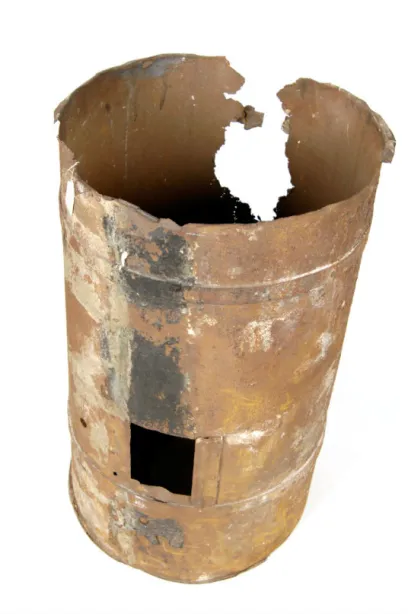
The Mint Street Workhouse Copper Pot.
The copper stood in the corner of the workhouse's large stone hall, where residents would have lined up with their bowls, waiting for their meagre portion. A circular brick wall around its base contained the fire that kept its contents warm or at least lukewarm.
When the workhouse finally closed, the pot was donated to the Cuming Museum in Southwark by the Workhouse Board of Guardians in 1921, a remarkable act of preservation that recognised, even then, that this humble cooking vessel was a piece of history worth saving.
The copper survived another chapter of drama when the Cuming Museum was hit by a bomb during the Second World War, damaging the brick base. But the pot itself endured, a battered, blackened witness to generations of hunger.
If you ever wanted a single object to represent the experience of poverty in Victorian Southwark, it would be hard to find anything more powerful than this copper pot, standing in its corner, day after day, year after year, feeding, barely, the people that society had forgotten.
The Lancet's Legacy
The Mint Street Workhouse was just one of many institutions exposed by The Lancet's investigation, but the cumulative impact of the series was enormous. The articles caused a public outcry that contributed directly to the passing of the Metropolitan Poor Act of 1867 a landmark piece of legislation that:
Established the Metropolitan Asylums Board to provide care for the sick poor
Created a new system of infirmaries separate from workhouses
Introduced the principle that the sick poor deserved proper medical care, not just a bed in a foul ward
It was a significant step forward, though, characteristically, reform came slowly and unevenly. The Mint Street Workhouse itself, despite being condemned by The Lancet, remained in use until the 1920s, nearly sixty years after the investigation that had called for its demolition. For the thousands of men, women, and children who passed through its doors in those intervening decades, the promised improvements were painfully slow to materialise.
The Mint in the Victorian Era
Beyond the workhouse walls, the broader neighbourhood of The Mint continued its long association with poverty and hardship through the Georgian and Victorian periods. Mint Street and the surrounding alleys remained home to some of Southwark's poorest residents. The area appeared regularly in reports by social reformers and public health investigators who documented conditions that shocked middle-class readers:
Overcrowding that defied belief - entire families in single rooms, multiple families sharing a house
Water supplies contaminated by proximity to cesspits and graveyards
Child mortality rates far above the London average
Occupations at the very bottom of the economic ladder — costermongers, rag-pickers, crossing-sweepers, laundresses, casual labourers
Charles Booth's famous poverty maps of the 1880s and 1890s coloured much of the Mint area in dark blue and black, his codes for "very poor" and "lowest class: vicious, semi-criminal." The area's reputation, it seems, had outlasted its legal privileges by more than 150 years.
Charles Dickens knew this part of Southwark intimately, not only from his childhood experiences of living in Lant Street and walking past the workhouse, but from his adult return visits to the area. In Little Dorrit (1857), he recreated the world of the Marshalsea with painful precision, and the broader atmosphere of debt, poverty, and desperation that pervaded the area seeps through many of his novels. The Mint and its workhouse were woven into the very fabric of the world that made Dickens the writer he became.
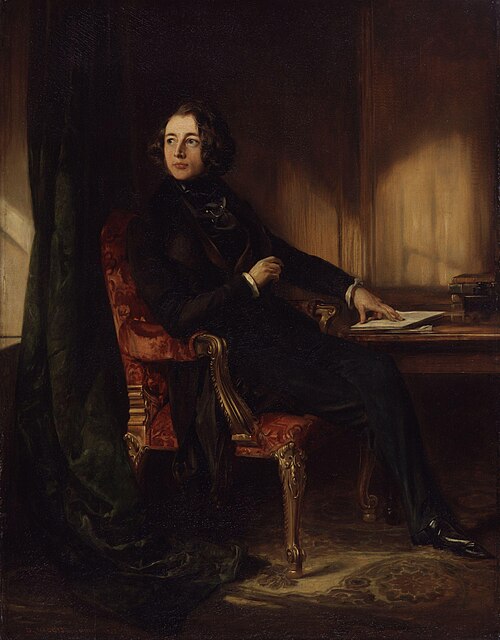
Charles Dickens in 1839, as portrayed by Daniel Maclise
Stories from The Mint
To give you a flavour of the kind of lives lived in The Mint, here are a few glimpses from the historical record:
The Debtor Who Became a King: In the early 18th century, one of the most colourful characters in The Mint was a man who styled himself the"King of the Mint"— a self-appointed leader who held court in a local alehouse, settled disputes, and collected tribute from new arrivals. His real authority was nil, but in a place with no legitimate governance, someone had to fill the vacuum.
The Bailiff's Revenge: Court records tell of bailiffs who, humiliated by the Minters, returned with armed gangs to seize their targets by force. These expeditions sometimes escalated into full-scale street battles, with dozens of people on each side.
The Children of the Mint: Perhaps the most poignant records are those relating to children, both within the workhouse and on the streets outside. Parish registers record the baptisms and — far too often — the burials of infants born in the Mint. Settlement examinations sometimes describe children apprenticed out to escape the poverty of the area, or taken into the workhouse when their parents could no longer cope. Inside the workhouse, the 1731 account of 25 children learning to read their catechism feels almost hopeful, but set against the later Lancet reports of typhus, straw-bedded wards, and starvation rations, the trajectory of childhood in The Mint is heartbreaking.
What Happened to The Mint?
The 20th century brought enormous changes. The workhouse finally closed in the 1920s, its copper pot donated to the Cuming Museum as a last memento. Slum clearance programmes, bomb damage during the Blitz, and post-war redevelopment swept away most of the old Mint. The cramped courts and alleys, the crumbling lodging houses, the ancient pubs, and the workhouse buildings — almost all were demolished.
Today, Mint Street still exists, running between Southwark Bridge Road and Borough High Street. Mint Street Park, a pleasant green space with a playground , occupies much of the land where the workhouse once stood, where debtors once hid, and where bailiffs feared to tread. Nearby, new apartment buildings and offices stand where some of London's most desperate people once eked out an existence.
A small stretch of original workhouse wall still stands at the edge of the park, a fragment of brick and mortar that once enclosed a world of hunger, disease, and desperation. It's easy to walk past without noticing. There is no blue plaque for The Mint itself. No grand monument. No museum. The area has been almost entirely forgotten, except by historians and, of course, by genealogists whose research leads them into its shadow.
Walking The Mint Today
If you're in London and want to visit the area where your ancestors may have lived, it's easily accessible:
Start at Borough Underground Station (Northern Line)
Walk south along Borough High Street— past the site of the old Marshalsea Prison (marked by a small section of surviving wall on Angel Place)
Turn right onto Mint Street— this was the heart of The Mint
Visit Mint Street Park— stand where the workhouse once stood, and look for the surviving stretch of workhouse wall. Try to imagine the crowded, chaotic neighbourhood that once surrounded you
Continue to nearby Tabard Street (formerly Kent Street) — another historically significant Southwark thoroughfare
Walk along Lant Street — where the young Dickens lodged, and imagine him walking this route every day, past the pauper children of the workhouse
End at St George the Martyr Church on Borough High Street — where many Mint residents were baptised, married, and buried. The church also has connections to Dickens'Little Dorrit there's a stained glass window commemorating the character
The walk takes about 30–45 minutes, but allow longer if you want to soak in the atmosphere and read the various information boards in the area.
New to Family History?
If this post has inspired you to start exploring your own family's past, whether your ancestors lived in the shadow of The Mint or somewhere else entirely, my free Beginner's Guide to Family History will walk you through everything you need to know to get started. From gathering those first clues to navigating records and building your family tree, it's all there.