Clandestine Marriages in 18th & 19th Century Britain | Fleet Prison to Gretna Green
Love, law, and the lengths people would go to say "I do"
Few chapters in British social history are as colourful, scandalous, and surprisingly romantic as the era of clandestine marriages. From secret ceremonies conducted in the shadow of London's Fleet Prison to breathless elopements northward to the Scottish border, the story of irregular marriage in 18th and 19th century Britain reveals a society wrestling with questions of love, money, class, and personal freedom that still resonate today.
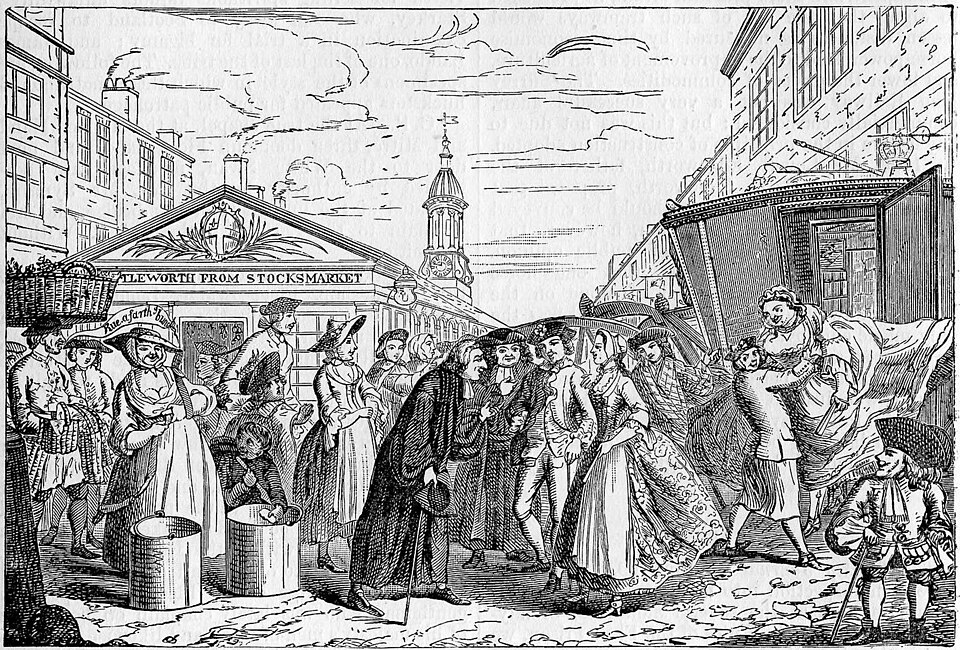
Victorian illustration of clandestine Fleet Marriages outside Littleworth from Stocks Market, after an earlier source, published in Robert Chambers’s Book of Days (public domain).
What Was a Clandestine Marriage?
In the simplest terms, a clandestine marriage was one conducted outside the normal legal and ecclesiastical rules governing matrimony. Before the landmark legislation that would eventually tighten the rules, the requirements for a valid marriage in England and Wales were surprisingly loose. Under canon law, a marriage was technically binding if two people simply exchanged vows of consent, no church, no banns, no witnesses strictly required.
This legal grey area created enormous opportunity for those who wanted to marry quickly, secretly, or without the knowledge or consent of their families.
The Fleet Marriage Industry
If you wanted a quick, no-questions-asked wedding in early 18th century London, there was really only one address you needed: the area surrounding the Fleet Prison in the City of London.
The Fleet was a debtors' prison, but it sat within a zone known as the "Rules of the Fleet", a surrounding area where prisoners with certain privileges could live under relaxed supervision. Crucially, this zone was considered to operate outside the normal jurisdiction of the Church of England's regulations. Imprisoned or disgraced clergymen, operating from nearby taverns, chophouses, and makeshift chapels, were happy to perform marriage ceremonies for a modest fee and absolutely no awkward questions.
It is worth noting that not all clandestine marriages were inherently disreputable. An irregular marriage was, technically, one conducted by an ordained clergyman but simply without banns or licence. While this breached canon law, such marriages could still be legally valid and were sometimes recognised as such under English Common Law. For many couples, the appeal was practical rather than scandalous, clandestine venues allowed them to avoid the considerable trouble and expense of obtaining an ecclesiastical licence, while affording a degree of privacy that a public church ceremony could not.
Business boomed nonetheless. At the height of the Fleet marriage trade in the early 18th century, it is estimated that as many as 6,500 marriages per year* were being conducted in and around the Fleet alone, and by the 1740s, it has been estimated that nearly 15% of all marriages in England were being celebrated in the Fleet. Touts, known colourfully as "plyers", would stand at the entrance to the area and grab the sleeves of passing couples, promising swift, cheap, and discreet ceremonies just yards away.
The Fleet parsons themselves became notorious figures. Men like the Reverend John Gaynam and Alexander Keith built small empires out of the trade. Keith, who operated from a chapel in Mayfair rather than the Fleet, was eventually excommunicated for his activities but continued conducting marriages regardless, even reportedly conducting ceremonies from his prison cell after his own incarceration.
The registers kept at these establishments were notoriously unreliable. Dates could be altered, names changed, and entries inserted retrospectively for a fee. A woman suspecting her husband of bigamy could find it almost impossible to prove anything from the chaotic, smudged, and frequently fraudulent Fleet registers.
Who Was Getting Married This Way?
The clientele of the clandestine marriage trade was fascinatingly varied.
Young lovers seeking to outrun parental disapproval were a staple. Wealthy families with property to protect were fiercely opposed to their children making unsuitable matches, and a Fleet marriage was a way to present the family with a fait accompli before anyone could interfere.
Soldiers and sailors heading off to war used the Fleet to tie the knot quickly before deployment, without going through the lengthy process of reading the banns — the public announcement of intent to marry that had to be read in church on three successive Sundays.
Widows and widowers who needed to remarry without alerting creditors or family members with an interest in their estates found the Fleet convenient and discreet.
And, more darkly, fortune hunters and outright criminals used the system to prey on vulnerable women. Young heiresses could be tricked, pressured, or even dragged into marriages that would immediately transfer control of their fortunes to a scheming husband. The law offered women precious little protection once the vows had been exchanged.
The Marriage Act of 1753: Hardwicke's Law
By the middle of the 18th century, public concern about clandestine marriages had reached a peak. Scandals involving kidnapped heiresses, fraudulent registers, and bigamous husbands filled the newspapers. Parliament decided to act.
The result was Lord Hardwicke's Marriage Act of 1753, arguably one of the most significant pieces of social legislation in British history. The Act came into effect on 25 March 1754, and it fundamentally transformed the rules of marriage in England and Wales.
Under the new law:
All marriages had to be conducted in the Church of England (with narrow exceptions for Quakers and Jews)
Banns had to be read publicly in church on three successive Sundays,ora special licence obtained
Anyone under the age of 21 required the written consent of a parent or guardian to marry
Marriages had to be conducted in a church or chapel and recorded in a proper register, signed by both parties and witnesses
Violation of these requirements rendered a marriagevoid— not just irregular, but legally non-existent
The penalties for clergymen conducting irregular marriages were severe: transportation for 14 years.
The Act was largely effective in England and Wales. The Fleet marriage industry collapsed almost overnight. But Lord Hardwicke and his legislators had made one significant geographical error.
The Act did not apply toScotland.
Gretna Green and the Road North
The Scottish border was approximately 330 miles from London. In an age of horse-drawn travel, that was a journey of several days. But it might as well have been the end of the world as far as English marriage law was concerned, because in Scotland, the old rules still applied.
Under Scots law, a declaration of consent before witnesses was all that was needed to form a valid marriage. No church, no clergyman, no banns, and, crucially, no parental consent required, even for minors.
The first village across the border on the main coaching road from London was a small place called Gretna Green.
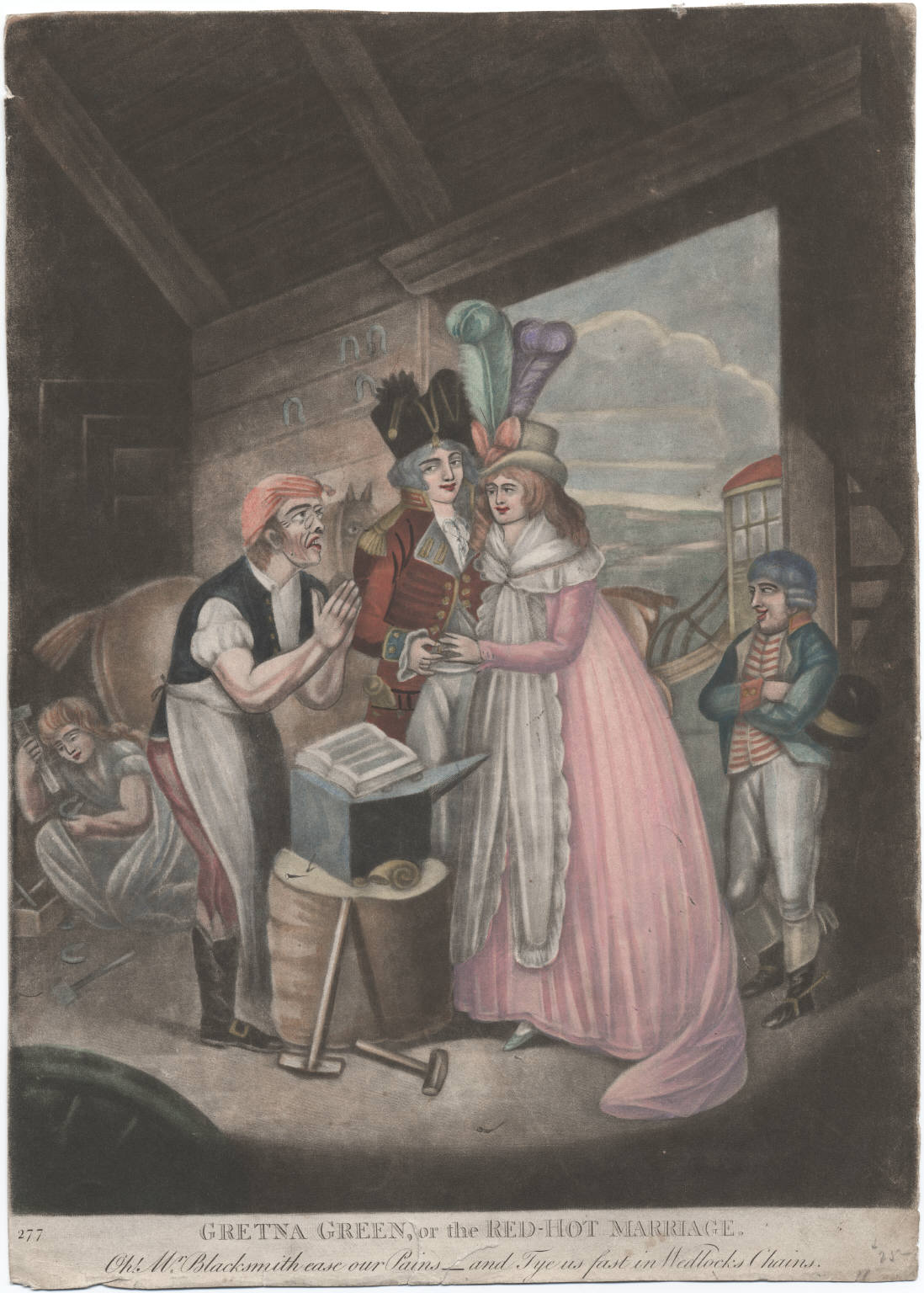
Gretna Green marriage at a blacksmith’s shop, showing an anvil ceremony for an eloping couple, a popular alternative to English marriage restrictions.
Almost immediately after Hardwicke's Act came into force, Gretna Green began its career as the most famous wedding destination in the world. Couples would flee north, often with outraged parents in hot pursuit, and marry the moment they crossed the border. The ceremonies were typically conducted by the local blacksmith, a figure who became so romantically iconic that Gretna Green marriages are still associated with the anvil to this day, or by anyone else willing to act as a witness to a declaration of consent.
The trade that grew up around runaway marriages made Gretna Green prosperous and famous. Inns competed for the business of eloping couples. The "marriage rooms" at establishments like Gretna Hall became celebrated, if slightly disreputable, institutions.
Not everyone made it. Pursuing fathers with fast horses sometimes caught up with couples just short of the border. And the journey itself was gruelling — young women, often travelling under duress or in great secrecy, endured days of uncomfortable, exhausting travel in all weathers.
The stories that emerged from this era are the stuff of romantic legend. Lord Erskine, future Lord Chancellor of England, eloped to Gretna in 1770. The elopement of Edward Gibbon's beloved was a source of personal heartbreak for the great historian. Countless lesser-known couples risked everything for the chance to marry the person they loved.
The Gradual Tightening of the Law
Parliament continued to fiddle with marriage law throughout the 19th century, gradually closing loopholes and tightening requirements.
The Marriage Act of 1836 made an important concession to nonconformists and Catholics, allowing marriages to be solemnised in registered places of worship other than the Church of England, and also creating the system of civil marriage before a superintendent registrar, a genuinely secular alternative for the first time.
But Gretna Green proved harder to suppress. It was not until the Marriage (Scotland) Act of 1856 that a significant obstacle was placed in the way of runaway marriages north of the border. The new law required that at least one of the parties must have been resident in Scotland for 21 days before the marriage could take place. This effectively ended the instant Gretna elopement, though the village continued to attract romantic visitors and conducted regular marriages.
Full legal harmonisation between England and Scotland on marriage law did not come for many decades more.
The Human Stories Behind the Statistics
It is easy to lose sight of individual human beings in the grand sweep of legal history, but the archives are full of extraordinary personal stories.
There were genuine love stories, couples from different classes who had no other way to be together, who risked social ruin and family fury to be with the person they had chosen.
There were tragedies, women deceived into marriages by men who had concealed a previous wife, or who disappeared the moment they had access to a fortune.
There were darkly comic scenes, pursuing fathers arriving at the border inn minutes too late, or Fleet parsons conducting ceremonies with magnificent indifference to the obvious youth or evident reluctance of one of the parties.
And there were the quiet, ordinary couples — the soldier grabbing a quick wedding before his regiment shipped out, the widow remarrying without wanting to go through the public ritual of banns, the apprentice and the shopkeeper's daughter who simply couldn't wait three Sundays.
A Legacy in Culture and Law
The era of clandestine marriages left a deep mark on British culture. It gave novelists endless material, Jane Austen's Lydia Bennet elopes with Wickham in a plot that hinges on exactly these social anxieties; the scheming seductions of countless Gothic novels depend on the same legal vulnerabilities.
It also gave us a lasting national institution. Gretna Green, despite the changes in the law, never really stopped being a romantic destination. Today it hosts tens of thousands of weddings each year, still trading on the glamour of its runaway past. The old blacksmith's shop has become a visitor attraction, and couples from across the world come to marry at the anvil in a ceremony that has absolutely no legal significance but enormous sentimental power.
More profoundly, the debates around clandestine marriage forced British society to think seriously about what marriage actually was, a religious sacrament, a legal contract, a social institution, or a private commitment between two individuals. Those debates were never entirely resolved, and in many ways, they continue to this day.
Conclusion
The clandestine marriages of 18th and 19th century Britain were not merely a legal curiosity or a series of romantic escapades. They were a symptom of deep tensions within a society that placed enormous weight on marriage as an instrument of property and social order, while simultaneously being populated by people with hearts that refused to follow the rules.
The Fleet parsons in their smoky taverns, the breathless couples on the road to Gretna, the legislators trying desperately to hold back the tide, all of them were part of a fascinating, chaotic, deeply human story. It is one that tells us as much about who we are as it does about who our ancestors were.
Interested in tracing ancestors who may have had a clandestine marriage? The surviving Fleet registers are held at the National Archives in Kew, and many have been digitised and indexed on Ancestry. Scottish marriage records are held at the National Records of Scotland in Edinburgh.
You might find these posts interesting
Elizabeth's Story: Uncovering a Clandestine Marriage in 18th-Century London Family History
Further Reading
Burn, John Southerden. The Fleet Registers (1833; modern reprints available)
The foundational work on Fleet marriages, detailing the history, the clergy involved, and extracts from the registers themselves.
Ashton, John. The Fleet: Its Rivers, Prison, and Marriages
A richly detailed Victorian account of the Fleet area and its notorious marriage trade.
Probert, Rebecca. Marriage Law and Practice in the Long Eighteenth Century
Excellent for understanding how and why clandestine marriages like those at the Fleet operated.
Outhwaite, R.B. Clandestine Marriage in England, 1500–1850
A key academic study exploring the scale, social context, and decline of irregular marriages.