How to Research Clandestine Marriages | Fleet Registers & Beyond | A Complete Guide
If you suspect that an ancestor was among the hundreds of thousands of people who married clandestinely in London between the late 17th and mid-18th centuries, the good news is that a substantial body of records survives. The bad news is that those records require a careful and informed approach. This guide explains where the records are held, how to search them, and, crucially, where to look beyond the Fleet Registers if your ancestor's marriage took place at one of London's many other clandestine venues.
What Were Clandestine Marriages?
A clandestine or irregular marriage was one conducted by an ordained clergyman but without the reading of banns or the obtaining of a licence. Although these marriages breached canon law, they could still be legally valid and were sometimes recognised as such under English Common Law. For many couples, the appeal was straightforward — a clandestine ceremony avoided the considerable expense of an ecclesiastical licence and offered a degree of privacy that a public church wedding could not.
Clandestine marriages took place across a surprising number of venues in and around London, as well as in some more unexpected locations further afield. Understanding which venue your ancestor may have used is the first step to finding the right records.
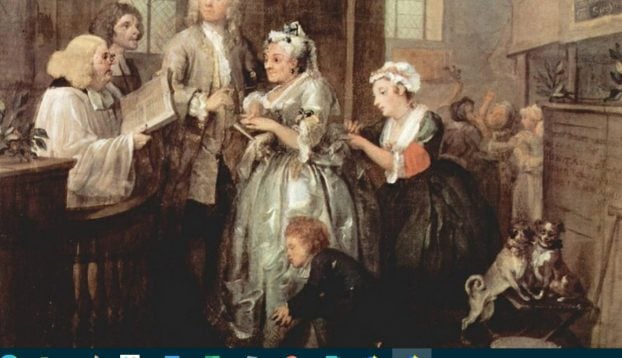
William Hogarth, A Rake’s Progress (1730s), depicting a satirical 18th-century marriage scene. Image via Wikipedia (public domain).
Where Did Clandestine Marriages Take Place?
The Fleet Prison is by far the most famous venue associated with irregular marriage, but it was far from the only one. Here is an overview of the principal locations:
The Liberty of the Fleet
The most notorious centre of the clandestine marriage trade, the Liberty of the Fleet was the area surrounding the Fleet Prison in the City of London. Clergymen operating from nearby taverns, chophouses, and makeshift chapels conducted marriages for a modest fee with no questions asked. At its peak in the 1740s, it is estimated that nearly 15% of all marriages in England were being celebrated in the Fleet. The Fleet Registers record ceremonies conducted here between 1667 and 1754.
The King's Bench Prison
Like the Fleet, the King's Bench Prison in Southwark operated its own zone of irregular jurisdiction. Clergymen imprisoned for debt or other offences conducted marriages within its precincts, and records of these ceremonies are included within the broader Fleet Registers collection held at The National Archives.
The Mint, Southwark
The Mint was a sanctuary area in Southwark, originally a place where debtors could claim refuge from arrest, that also became a venue for clandestine marriages. Ceremonies conducted here are also captured within the Fleet Registers collection.
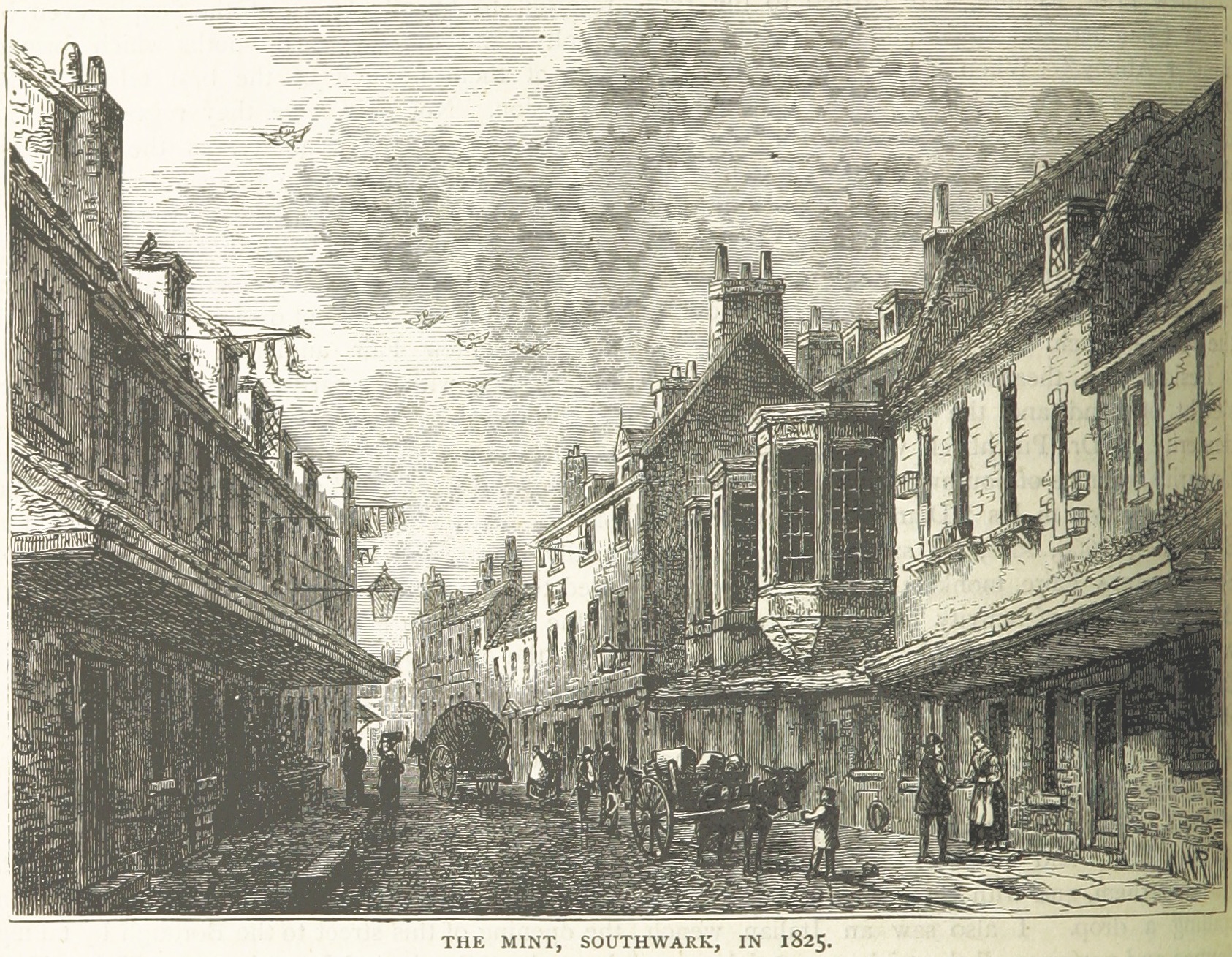
The Mint, Southwark, London, 1825. Engraving from Old and New London, reproduced from the British Library’s Mechanical Curator Collection (public domain).
Keith's Mayfair Chapel
Alexander Keith operated one of the most prolific irregular marriage businesses in London from his chapel in Mayfair. Keith was eventually excommunicated for his activities but continued regardless, reportedly even conducting ceremonies from his prison cell after his own incarceration. His chapel was a rather more upmarket alternative to the Fleet for those who could afford it.
The Chapel of the Tower of London
The Chapel Royal of St Peter ad Vincula within the Tower of London was another venue where irregular marriages were conducted, exploiting the Tower's status as a royal peculiar, a church that fell outside the normal jurisdiction of the diocese.
Holy Trinity Minories
Holy Trinity Minories was a church just outside the City of London walls, in an area that also claimed exemption from the usual ecclesiastical regulations. It became a popular venue for clandestine marriages, particularly in the late 17th and early 18th centuries, and its registers survive and have been studied by genealogists.
St James' Duke's Place
St James' Duke's Place in Aldgate was another church operating as a royal peculiar and therefore outside the authority of the Bishop of London. It conducted large numbers of irregular marriages, often without banns or licence, over many decades, and its registers are an important source for researchers.
Fledborough, Nottinghamshire
Not all clandestine marriages took place in London. Fledborough is a tiny village in Nottinghamshire that became an unlikely centre of irregular marriage in the early 18th century, primarily through the activities of its incumbent clergyman, the Reverend William Sweetapple, who conducted marriages for couples from across the country without banns or licence. For ancestors from the East Midlands or beyond, Fledborough is well worth investigating.
What Are the Fleet Registers?
The Fleet Registers are a collection of registers and notebooks recording more than 200,000 marriages, and some baptisms, conducted clandestinely in London between 1667 and 1754. Despite the name, the collection covers ceremonies at multiple venues, including the Liberty of the Fleet, the King's Bench Prison, the Mayfair Chapel, and the Mint.
The collection ends in 1754 with the coming into force of Lord Hardwicke's Marriage Act, which made clandestine marriages in England and Wales legally void.
A Word of Caution
Before you begin searching, it is essential to understand the limitations of these records. Because of their irregular and often commercially motivated nature, the Fleet Registers must be used with considerable care. Known problems include:
Duplicate entries: the same marriage recorded more than once, sometimes with variations in detail
Forged entries: records inserted fraudulently, either at the time or retrospectively, for a fee
Inconsistent or unreliable information: names, dates, and parishes of origin are not always accurately recorded
Incomplete coverage: not every clandestine marriage was recorded, and some records have been lost
This does not mean the registers are useless — far from it. But any information found in them should ideally be corroborated against other sources before being accepted as definitive.
Where Are the Records Held?
The Fleet Registers are held atThe National Archivesin Kew, under record seriesRG 7. The collection is divided as follows:
In addition, two registers submitted as evidence to the Prerogative Court of Canterbury in 1726 and 1735 survive separately under reference PROB 18/50. These are not available online and must be viewed in person at The National Archives in Kew.
Searching Online
The Fleet Registers are available throughthree major platforms:
Ancestry
Ancestry holds a searchable collection of the Fleet Registers, which can be accessed at:
ancestry.co.uk/search/collections/5344
This is often the best starting point for most researchers, particularly if you already have an Ancestry subscription. The collection includes both indexes and images of the original registers.
The Genealogist
The main RG 7 series has also been digitised and is available throughThe Genealogist at thegenealogist.co.uk— charges apply. If you already have an RG 7 reference code from one of the printed indexes described below, you can use The Genealogist's Advanced Search function to go directly to the relevant register or notebook.
FamilySearch
Some indexes are available free of charge through FamilySearch at familysearch.org. Coverage on FamilySearch is partial and consists of indexes rather than full images, but it is worth checking as a free first step before committing to a paid search elsewhere.
Indexes Available at The National Archives
Several indexes to the Fleet Registers exist that arenot currently available onlinebut can be consulted in the reading rooms at The National Archives in Kew. These can be invaluable for narrowing down a search before working through the registers themselves.
If your ancestor came from London or one of the home counties, these indexes are a sensible first port of call before attempting to search the registers directly.
Records for Other Clandestine Venues
If you believe your ancestor married at one of the other clandestine venues rather than in the Fleet itself, here is where to look:
For all of these venues, it is also worth searching Ancestry and FamilySearch, as records from multiple clandestine venues have been digitised and indexed across both platforms.
Tips for Researchers
Start with Ancestry. The Fleet Registers collection on Ancestry is the most accessible starting point for most researchers and can be searched by name, date, and location.
Start with what you know. If you have a rough date and the names of both parties, you are in a much stronger position than if you have only one name. The more information you bring to the search, the better your chances of a positive result.
Be flexible with spellings. Names in the Fleet Registers are frequently recorded phonetically or inconsistently. Try variant spellings of both surnames and given names.
Think beyond the Fleet. If you cannot find a marriage in the Fleet Registers, do not assume it did not happen clandestinely. Consider whether your ancestor might have married at one of the other irregular venues described above.
Cross-reference where possible. If you find a likely match, look for corroborating evidence in other sources, parish records, wills, legal documents, or family papers, before treating the identification as certain.
Consider the geography.The majority of couples who married at the Fleet came from London and the surrounding counties. If your ancestor was from the East Midlands, Fledborough may be a more likely venue than the Fleet.
Use the on-site library at Kew. The National Archives maintains an extensive library and reading room with specialist publications on the Fleet Registers and related subjects. Staff can advise on the best approach for your particular research question.
Scottish Clandestine Marriages
If your ancestor's clandestine marriage took place in Scotland — at Gretna Green or elsewhere — the relevant records are held at the National Records of Scotland in Edinburgh. Scottish marriage records can be searched through ScotlandsPeople, the official Scottish Government genealogy website, at scotlandspeople.gov.uk a modest fee per search applies.
For the full story of why Gretna Green became such a famous destination for runaway couples, see our companion post: The History of Clandestine Marriages in Britain
Read the story of my ancestor Elizabeth Ivory's Clandestine Marriage here.
The National Archives is located at Kew, Richmond, Surrey, TW9 4DU. Opening hours and visitor information are available atnationalarchives.gov.uk. Pre-booking a reader's ticket is recommended before your first visit.